Blog
Q&A with Mario Petrucci
Monday 11th May 2026
Candlestick Press
-
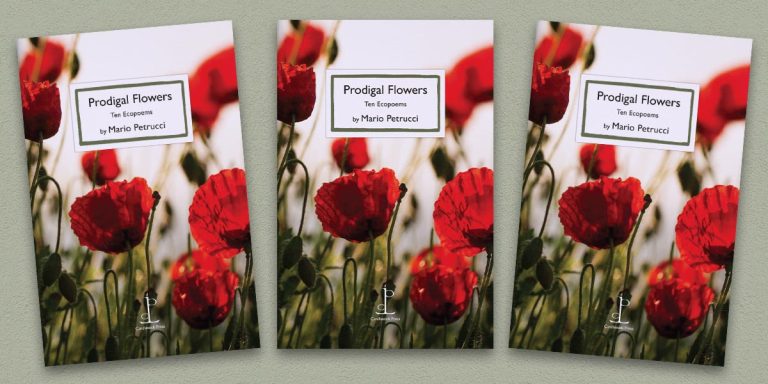
KT – We’re hugely excited to be publishing this pamphlet containing ten of your wonderful ecopoems. Perhaps you could introduce it to readers by talking a little about the intriguing title Prodigal Flowers?
MP – Ah, let’s not be too keen to dispel the mystique of the title! I’d much rather that readers read, and interpret in their own way, than I, as author, explain away. So, for all true readers, beware: Spoiler Alert! The phrase comes from the poem where bees are:
crissing & bumbling algebraic fields &
all the weedless grassfor one prodigal flower
‘Prodigal’ seems to gather in, simultaneously, that sense of Gaia’s abundance, her unconditional extravagance, along with the narrative of the well-known scriptural reference. Chastened by the consequences of profligacy, perhaps we can return home in strength and humility, like the bee? I’m hoping mother Gaia will give us the same reception as the father did in the biblical story. But some of you will notice, in the poem, that it is the nectar-giving flower that’s described as ‘prodigal’, not the visiting bee who benefits from the bloom’s generosity. Surely, that’s the wrong way round? Well, remember that the flower gets something out of the transaction too. We are as much a part of Gaia as anything else, so in a sense, paradoxically, we too are the flower of nature that can render something back to Gaia who is also the bee. Ecology is all about relationship, reciprocity: the forgiven returnee is blessed, yes; but so is the forgiving parent.
-
DS – What do you like about the pamphlet form for these poems – is there something about the brevity and portability of the format that particularly lends itself to ecopoetry and the urgency of the message? Of course, pamphleteering has a whole history of activism through the ages!
MP – Yes, there can be impact in brevity, especially for modern attention spans. To quote myself from an old article: “The poetry pamphlet’s long lineage – from the loins of its twelfth-century protomorph (Pamphilus, seu de Amore) via the likes of Luther, Pascal and the Chartists – seems far from petering out.”
-
KT – How do you think an ecopoem differs from a poem that’s simply about (or paying attention to) the natural world? How would you describe that difference – if you think there is one?
MP – There is, indeed, plasticity in the definition. For some, and in informal use, an ‘Ecopoem’ is simply any poem that addresses the environment, or is responsive to it, in any way whatsoever; for others, it is a special category of poetry that involves some kind of radical insight or challenge; or it is taken as an academic term to denote artworks/practices that preserve, remediate, or actually vitalise ecology itself, often in a site-specific way. I think we can accommodate all such definitions; all approaches are useful and can coexist.
-
DS – You’re a PhD scientist as well as a poet. How do your poems reflect your life in the scientific world?
MP – I might be unusual in this, but I find that my main desire in writing a poem is, in some ways, quite similar to the desire I had to be a physicist, which is to get to something that can’t be found trivially, or superficially. I’m not looking anymore in poetry for something that can be said easily, that can be pointed to rather like a planet in the field of view of a telescope, defined straightforwardly in terms of its measured spectrum and so on. Actually, that’s one reason I went into my particular branch of physics, an area that was little known and little explored. Optoelectronics at that time was an opening field, a relative ‘Waste Land’ of ideas that nobody had really gone into yet. I suppose, with poetry, I’m attempting to do the same: I’m exploring that old/new path of the Modernists, which is to say that language is inexhaustible, language has an infinity of undiscovered possibilities. We’ll never have the ‘Grand Unified Theory’ of language, but we can revel in it, in all its fuzzy richnesses and (im)precisions. And language seems to me to be one of the cardinal angels accompanying humanity in its incredible experiment of ‘being here’ in an all-embracing, indispensable environment.
-
KT – In some of the poems, the lives of wild creatures and of humans seem almost to merge. In ‘Wolf’ for example, it’s as if the speaker is turning into a wolf him/herself. Could you talk a little about this imaginative leap and how it works in the poem?
MP – I hope this won’t sound evasive, but I’m usually pretty reluctant to convert – into something more linear and obvious – the multidimensional meanings and supple interconnectedness of poems. Firstly, for me, unless it’s somehow expedient to some local or temporary requirement such as teaching, it usually seems second best to cut corners by paraphrasing what is meant to be unparaphrasable. Secondly, doing so usually feels a bit like a comedian having to explain their jokes on stage! Or rather, a farmer turning an ancient forest into sparse grassland. Thirdly, why should my interpretation of what I’ve written trump yours? Lastly, there’s so much going on in the poem, it would take ages. That doesn’t mean, of course, that the author cannot point to anything at all. For instance, there’s a lot in the opening lines that informs the rest of the poem:
Who now
can live wildness?May I humbly suggest we simply stay with those lines a moment, and when we feel ready, go find the poem?
-
KT – Auden famously said that “poetry makes nothing happen”. Do you think ecopoetry can make a difference and, if so, what are your hopes?
MP – That Auden quote is famous, but I feel it’s often misread, used to suggest that poetry is, at heart, ineffectual and impractical. However, later in the same poem, Auden adds: “With your unconstraining voice/ Still persuade us to rejoice”. That’s a clue, I think, to how we might re-read the preceding phrase. Perhaps the sense here is not: Poetry makes nothing happen, but: Poetry does not make anything happen. So, poetry doesn’t force, cajole or constrain; it persuades. It guides us to openings, possibilities, and ultimately to that empowering ‘nothing’ which is indeed a happening, which suggests itself, tangibly, beyond content – rather like the carrier wave in a radio signal. In that ‘Ur’ sense, then, all poetry is (sort of) Ecopoetry, if it challenges our perception to go deeper, to resist the superficial and simply gratifying, to understand more intimately what we are, what Otherness is. That doesn’t mean to say that all art has to be serious and desperate; but if art, if poetry, as a whole or in main, fails to do this, then it probably becomes complicit in the insidious human tendency to deny our agency and responsibility in ecological decline, to exchange our sacred eternal kinship with Life for material convenience, to constantly disrupt peace in order to more usefully exploit one another and the communal environment; on the other hand, any poetry that speaks truth, however particular or private that truth may be, mostly serves to reverse that betrayal of connection and responsibility. So, finding some way to balance our species with Gaia is, for me, certainly about rediscovering responsibility (both individually and geopolitically) as well as our fundamental connectivity with other creatures, with the soil and air and water, and ultimately one another. Having now laid all of this out, I would hope it’s fairly self-evident how Ecopoetry can assist!
In terms of Ecopoetry actually making obvious tangible differences out there amongst the physical reality of things, though, we might need a reset. We must first establish why it is that great and persuasive art hasn’t simply ‘saved the world’ in practical terms in the day-to-day. Why is the scientific community and the UN still asking the same pressing eco-questions as 40 years ago, when we already mostly knew, way back then, what was going on? Well, there are, at the very least, three factors in society that hold back a fully creative contemporary consciousness that’s in harmony with ecology. These factors actively prevent appropriate and effective action from being taken to undo current abuses. These are: bad ‘memes’, ‘Radical Inertia’ and ‘Framed Questions’. A meme is a self-replicating unit, a recurring splinter, of culture. Memes propagate across generations, often mutating as they go (think of a famous folk melody, a TV catchphrase, a slogan that makes a neat headline). I don’t completely believe in memes; but when I look at how certain assumptions, values and behaviours are perpetuated against the tide of data that calls for deep revision, the notion of a ‘bad meme’ does seem to offer a useful partial idea. Next, Radical Inertia. That’s a deep resistance to change, encountered when an existing way of doing or seeing things is ingrained in us – not just ideas, but infrastructure, laws, etc. We’d come up hard against Radical Inertia if we tried to abolish the use of fossil fuels, say, or TV, or adverts. Finally, Framed Questions are questions with an agenda, posed so that only certain ‘answers’ are possible. They happen in politics and art because so many of our assumptions are largely invisible to us (the idea that economic growth is always good, and so on). “Shall we build 5 or 10 nuclear power stations in our term of government?” That’s a Framed Question. If you think about it, so is: “As a poet, how do I find my voice?”
What can poetry do about this three-legged stool of trouble? Well, by heightening our awareness of the detailed texture of perception, by revealing private and collective thinking, by making the habitual and familiar unfamiliar – that is, through ‘defamiliarisation’ – great poetry can saw through all three legs on which denial and unsustainability squatly sit. Another strength of poetry is its ability to transform us. Transformation dents Radical Inertia. Rilke: “What is your most pressing injunction, if not for transformation?” (The Ninth Elegy; my translation). One expects some of our poetry, at least, to have transformative potential stored in its DNA. Moreover, where poetry opens us to wider truths, when it reveals our selves to ourselves, it facilitates a breaking up of Framed Questions. Great poetry often challenges the dominant ideology and stimulates radical shifts in perspective, cracking Framed Questions open with its forensic, interrogating insights and its plural trajectories through mind and heart. Poetry can also nurture connection, empathy and sensitivity: qualities essential to eco-conservation. What’s more, good poetry is meme-proof, because it can’t be pinned down to one-eyed meanings, that charge of the Cyclops herd. It operates on several levels at once, across apparent boundaries and hermetic dimensions. Australian poet, Les Murray, said: “Only poetry recognises and maintains the centrality of absolutely everywhere”. Maybe poetry is one way to generate Lorca’s “Green wind” that eventually makes contact, all to all. Finally, all genuine art is a kind of ‘what if?’ It encourages us, indeed can train us, through its ‘what ifs’, to recreate ourselves, to recognise patterns (even those habits we might prefer initially not to look at) and to shift them. Great art deflates denial. Great art, if we let it, reboots consciousness.
But art can be part of the disease too. Remember all that awful pro-war verse at the start of WW1. So, am I referring to the avant-garde? Not necessarily. What I’m indicating, maybe, is any poetry that possesses radical, authentic intent, or that observes so intimately and sensitively that we’re profoundly changed by it. Poetry that pierces. Poetry that can ramify, into the culture, the integrity and insight of those individuals who are still, in some way, more fully awake, more completely connected. Any poetry that does this becomes, by association, ‘Ecopoetry’ (or a close cousin to it) because without these motivations, mobilisations and re-awakenings of the human spirit we remain individually trapped in ourselves as we are, in our seemingly separate and disconnected selves, whilst being trammelled collectively by the myriad systems of unsustainability our culture has invested so much in for so long. Foremost, in this, one is helped by having rich and actual relationships with the environment: we can’t all just read about it in sealed tower blocks. But reading, too, is part of human experience, so poetry contributes something powerful and important, even if it’s just a seed-crystal for a much larger development. So, when you read a poem, never mind about definitions or reputations or fads or trends; instead, ask yourself: “How far is the art/poetry I’m experiencing part of the cultural wound or part of its healing? Is it perpetuating unhelpful memes, especially those I might not immediately register?” And that’s not just about ‘content’, or what the poem is, on its surface, saying: it’s also about the taproots of language itself.
To address all of this is not something quickly achieved over a cup of sustainably sourced coffee. One of the poems in the pamphlet shows how nature has a persistence and resilience to it, an ability to at least appear invincible or irrepressibly productive, which can allow us to conveniently anaesthetise and mesmerise ourselves into a form of denial where we continue with what we’re doing as if everything is alright, like a rosemary stem clipped off its bush and abandoned to a seemingly sustaining cup of water:
That’s how we seem
(how I am)
upon this planet:
one shoot whoseblooms so
delicately cupped
for nowkeep on
opening even as we
separatefrom the root.
The poem serves to remind that we can flower even as we perish.
-
DS – What makes for a good reader experience of ecopoetry? How can we encourage more readers to this important work?
MP – As in asking whether Ecopoetry can ‘make a difference’, we’re again forced away from trivial catchphrases and deep into the whole global set-up, a terrifyingly rigidified and extremely dark forest of systems, politics, ideologies and economic drives, all sustained by (and sustaining) first-world lifestyle addictions. Ecopoetry, and Eco-art in general, provides us with a low-carbon lamp; but we have first to acknowledge that every single one of us must hold aloft our lamp. Sometimes, then, the ‘good reader experience’ won’t feel particularly good; it will mean seeing all too clearly, without flinching, a profoundly unpleasant truth. Other times, that same work can also be artistically served by engendering splendour, humour, sensory richness, joy. We must laugh, as well as weep, our way to salvation. Oh – by the way – we also absolutely must STOP devouring our young.
How important is it that poetry takes on this task? It’s crucial that everything addresses this issue… we are all sinking our one Lifeboat. (Who that “we” is, is yet another full-length blog I’m afraid.) That said, I prefer to see it not so much as a ‘task’ but as a privilege to rediscover the existential sweetness and sheer miraculousness of Gaia’s bounty, to see again (as most children do, until our systems recondition them) that our most precious asset is nature, and to embrace that greatest wonder of all: consciousness. I simply do not get how casually we seem to take consciousness for granted, or what we typically use it for! It is the single most astonishing fact about the universe, easily, and for anyone alive their only true capital. Just try imagining yourself without it!
-
DS – What advice might you give to other poets wanting to write for the planet?
MT – Read Otherness. Don’t be a tourist in your own consciousness. Rediscover yourself.